

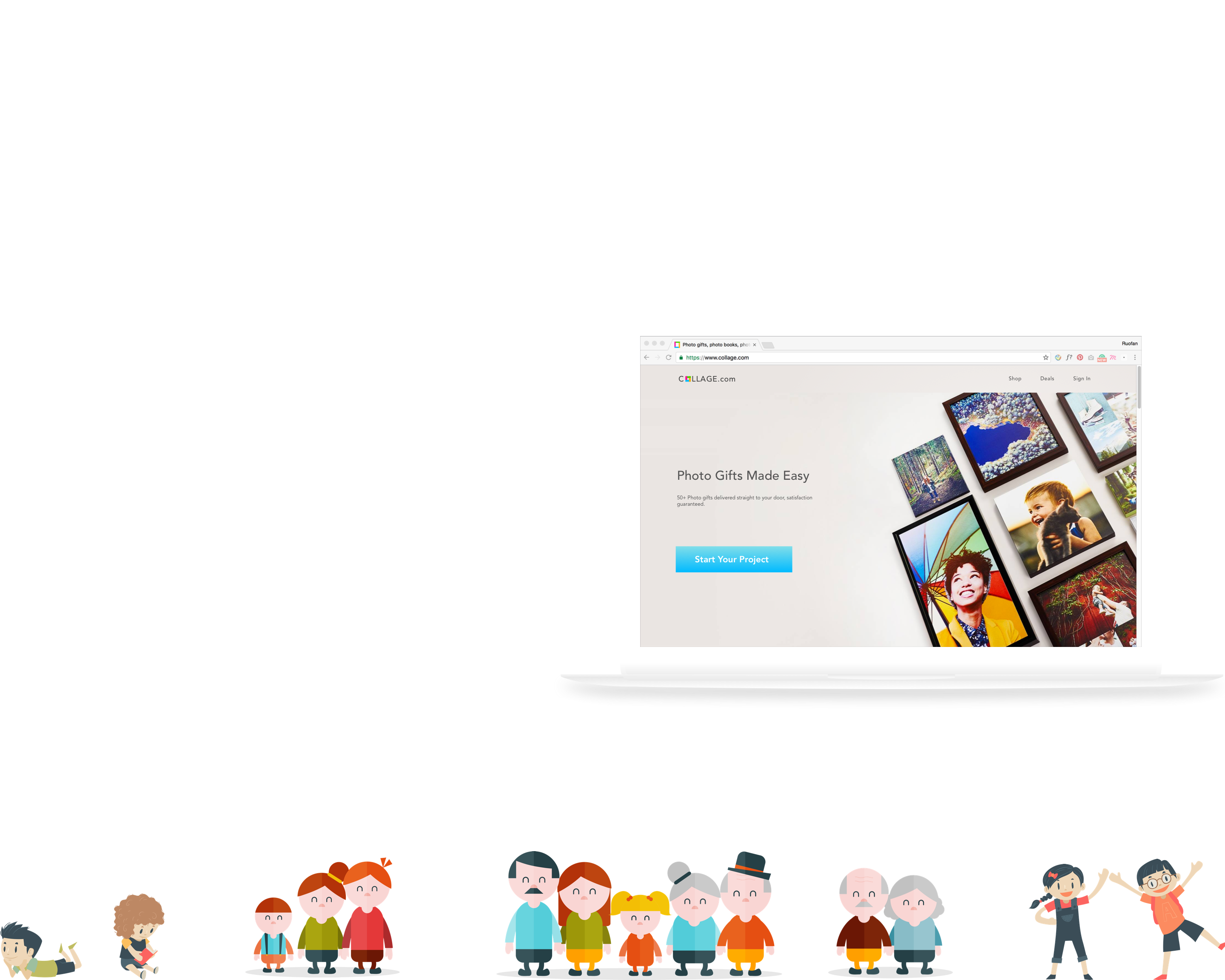
Collage.com is a website that allows users to create customized products using their own photos. It offers users with a large variety of product options from blankets to puzzles and photo customization and editing tools. Because Collage.com was initially intended for creating products with multiple photos, but a significant number of users are using only one photo, the primary problem will be focusing on is how to improve the customer’s experience of creating a product using only one photo as opposed to the site’s standard multiple photo option. The company is also thinking about their expanding their market demographic but would like to focus on improving the site’s usability before doing so.
To review and analyze the usability of Collage.com, we used user-centered design methodology including qualitative researches and quantitative researches. At every phase of the project, we provided findings and recommendations based on our researches.

By synthesizing all research results, we concluded major usability issues users faced that arose from the website’s information architecture, lack of system feedback, and wording. Among those, the ones appearing on the photo customizing page have the most negative influence.

For each of the key findings above, we developed the corresponding recommendations.

This project gave me a taste of commonly used UX research methods from the collaboration with a real-world company. What left a great impression on me was the survey part, where part of the responses completely contradicted what usability tests revealed later. For example, more than 60% respondents thought the photo editing functions were fairly easy or extremely easy to use, whereas 5 out of 5 participants in the usability tests reflected they were so confused by that part. Through discussion and analysis afterwards, we speculated the possible reasons could be :
1) Self-selection bias
Since individuals willingly chose to participate in the survey, there was self-selection bias. The selection could be perceived as biased in two ways. First, because we offered a coupon for those who took our survey, it was quite possible that the incentive encouraged people to take the survey when they normally would not have. Second, it was also possible that people who were overall satisfied with Collage.com were more wiling to take the survey than users who had a negative experience with Collage.com and did not want to share or reflect on their experiences.
2) Sample bias
92% of the survey respondents have ordered from collage.com at least for once, whereas all of the usability participants were new to the website. This could be another major reason, since the more familiar you are with a system, the easier it is to you. To eliminate this bias, it is necessary to send the survey out to more first-time users, then to compare its results and the usability tests.